
The AI Promise and the Reality
Artificial Intelligence is often positioned as the next great leap in industrial innovation. From predictive maintenance to automated decision-making, AI promises to unlock higher productivity, better forecasting, and smarter operations. But for many organizations, the reality has been less transformative than expected.
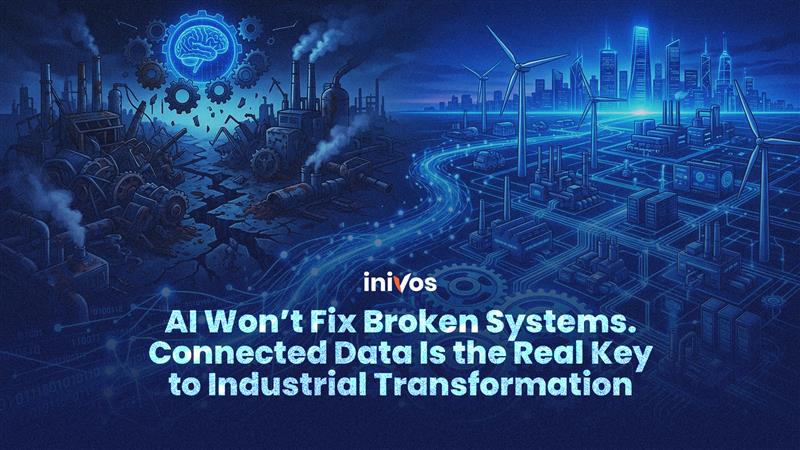
The reason is simple: AI cannot create value in isolation. The companies achieving real gains from AI today did not begin with advanced algorithms or experimentation. Instead, they first invested in building connected operations by integrating systems, aligning data, and creating a unified digital backbone for their businesses. Only then did AI become the catalyst that accelerated performance.
Why Data Connectivity Matters
AI thrives on data. But not just any data, it requires accurate, consistent, and connected information that flows across the entire organization.
In many traditional industrial environments, data is scattered across multiple systems. Production information may exist in one platform, inventory data in another, and financial records in a completely different system. When these systems do not communicate with one another, organizations end up with fragmented insights and inconsistent decision-making.
In such environments, AI cannot function effectively. Instead of generating intelligent insights, it simply adds another layer of complexity to already disconnected processes.
This is why connected data is the true foundation of successful AI adoption. When information flows seamlessly between operations, AI can transform that data into predictive insights, automated decisions, and operational improvements.
The Hidden Cost of Fragmented Systems
Many organizations have attempted digital transformation through gradual improvements by introducing new tools, testing isolated technologies, or running limited pilot projects. While these steps may appear practical, they often create unintended consequences.
Disconnected solutions lead to data silos, where each department works with its own version of the truth. Operations teams, finance departments, and supply chain planners may all rely on different datasets, making it difficult to establish a clearand unified view of performance.
The result is a heavy manual burden. Skilled employees spend hours gathering information, reconciling reports, and moving data between systems. Instead of focusing on innovation and problem-solving, they are caught in an endless cycleof operational administration.
Without addressing these foundational challenges, AI initiatives struggle to deliver meaningful outcomes.
Whatan AI-Ready Operation Looks Like
Organizations that successfully adopt AI share a common characteristic which is that their operations are fully connected.
In an AI-ready environment, information moves seamlessly across production, supply chain, and business systems in real time. Production equipment continuously reports performance metrics, supply chain systems provide end-to-end visibility, and teams have instant access to accurate operational data.
This level of connectivity enables three critical capabilities:
1.Intelligent production, where machines and sensors generate data that supports predictive maintenance and process optimization.
2.Responsive supply chains, where demand signals, supplier information, and logistics data are integrated to enable faster planning and disruption management.
3.A connected workforce, where employees can access operational insights instantly, helping them make faster and more informed decisions.
When these elements work together, organizations move beyond incremental improvements and achieve a step change in operational performance.
Why ERP is the Foundation of AI Success
At the center of connected operations lies a modern ERP platform. For many organizations, legacy ERP systems are the biggest barrier to AI adoption. Outdated architectures often rely on batch processing, limited integration capabilities, and isolated data environments.
Modern cloud-based ERP systems, however, provide the unified infrastructure that AI requires. They allow real-time data processing, seamless integration across operations, and scalable platforms capable of supporting advanced analytics.
With the right ERP foundation, AI can transform from a promising technology into apractical driver of efficiency, insight, and innovation.
The Time to Act Is Now
AI is already changing how leading manufacturers operate, compete, and serve customers. As digital transformation accelerates, the gap between connected organizations and those relying on fragmented systems continues to grow.
For industrial businesses, the message is crystal clear that AI is not the starting point of transformation, it is the multiplier.
The real advantage lies in building the connected, AI-ready foundation that allows intelligence to flow across the entire enterprise. Organizations that take this step today will be the ones shaping the future of industrial operations tomorrow.


.png)
